Montesquieu’s most famous and most ambitious work is The Spirit of the Laws. It is a large book, often plundered for succinct guides to good government. In writing that book, Montesquieu claims to have drawn his principles “not from [his] prejudices but from the nature of things.” (SL, Preface).What he sought was a science of human affairs.
I will say only a bit more about The Spirit of the Laws here. The book I will focus on is Persian Letters, a book composed of the letters of a pair of Persian exiles he finds at first ‘ignorant and prejudiced’. The letters show the exiles’ gradual but incomplete enlightenment and, I argue, provide the reader with an image of Montesquieu’s critique of Cartesian science. In Persian Letters Montesquieu interrogates the Cartesian soul and shows it to be at odds with itself. In the process Persian Letters challenges us readers to free ourselves from the oppression of chains that link “our dogmas” with “our other truths” (Reflections, PL). The uneasy alliance Descartes forges between the Christian God and the guarantor of truth whose existence he proves in the Discourses and the Meditations is an example of the link Montesquieu examines. He caricatures Descartes in Persian Letters only to extend, perhaps complete, his project.
The connection between Montesquieu and Descartes is not immediately evident, so I will offer a bit more context for my claim.
In a work on natural history[1] Montesquieu proclaims that he is a ‘strict’ Cartesian. What does he mean by this claim? Like Descartes, Montesquieu rejects accounts of human life that begin with theological and academic presuppositions. He rejects final causes and natural wholes. He finds laws everywhere. His Cartesianism leads him to new projects. In the first chapter of The Spirit of the Laws Montesquieu lays out the main types of law that govern human beings. To begin with, there are laws of body and mind: insofar as we are physical beings, we are subject to laws that govern bodies. We are also intelligent beings. As such we are limited, and our limitations lead to violations of the laws God has given us as well as the laws we make for ourselves. If one intelligent being, Montesquieu says, has done a kindness to another, the recipient ought to feel gratitude. But passions and prejudices make us forgetful of the laws that must govern intelligent beings and thus of our place in the larger wholes we inhabit. This is why, in order to live well, we require explicit laws of religion and morality, as well as political and civil laws. What are the appropriate laws? These depend, according to Montesquieu, on the true relations among things, and therefore vary with those things. Knowledge of these relations is possible. Like Descartes’, Montesquieu’s goals are limited: we can achieve not the knowledge of the true natures of things but of how they relate. Unlike Descartes, who barely acknowledges human affairs, Montesquieu discerns a web of interactive laws that affect how each human being lives in society. In The Spirit of the Laws, Montesquieu creates a ‘post-Cartesian political science’. In Persian Letters we can see hints of that project. I will focus on the drama of Persian Letters, which illustrates the need and at least one of the principles for the political science of The Spirit of the Laws, namely honor. I will return, briefly, at the end of this paper to the implications of the novel for a science of politics. Here is a preview of the trajectory of the book as I see it:
Many of the letters of the Persian Letters are written by Usbek, a Persian who has left his country and his seraglio to travel to Europe and learn about western science. Usbek is Montesquieu’s most Cartesian character, a man without a country devoted to the pursuit of knowledge through the recognition of universal laws. Most of the reflections on justice, economics, religion and even the family are articulated by him, and they constitute a consistent rejection of despotism. His letters span eight years and a half, during which Usbek’s lack of self-knowledge remains as stunning as his intellectual progress.
The story begins when Usbek and his younger friend Rica leave Persia to travel in Europe. As foreign observers they discern many absurdities of French government and society while they reflect on the laws and practices of their home. Rica has only one tie to Persia, his mother, whom he evidently forgets: he adapts happily to French society with its easy relations between men and women. It is a voluntary exile for both men, although for Usbek it is motivated by fear for his life: in Persia his devotion to truth and “virtue,” according to his own account, made him hated. His virtue is not immediately apparent in his lordship over his seraglio, which he never repudiates, although he does try to rule with persuasion. Like a distant God, he wishes his subjects to love him even from afar. In the end he is confronted with the fact that his favorite wife has always hated him. The life he thought he was leading – a pursuit of individual virtue and scientific inquiry – turns out to rest on a contradiction[2], and confronting it renders him impotent in every respect.
Usbek fears the dishonor of losing control of his seraglio. This fear maintains such a grip on him that when his wives rebel and the order of the seraglio is destroyed, he is paralyzed and distraught. The concern with honor is not peculiar to Usbek.It is shared by his wives. Their rebellion points to the need for a way to reconcile the multiplicity of spirited souls into some sort of workable social whole.
This paper has four parts:
I. The action of the novel: the self-destruction of the Cartesian “I.”
II. Usbek’s scientific and political enlightenment
III Usbek and his wives
IV. Rebellious Subjects, Competing Despotisms.
- The action of the novel: the self-destruction of the Cartesian “I.”
In Montesquieu’s own words, the Persian Letters is a “sort of novel. ”The action of the book is the self-destruction of despotic rule in the seraglio, and the complete collapse of its master. This collapse mirrors the failure of the pretended alliance between the foundation of Cartesian science - the inference “I think, therefore I am” - and the Christian God.
In many of his letters, Usbek displays a desire to find lawful patterns by which to understand human relations. He articulates enlightened, even liberal, views. He also repeatedly insists on his continuing allegiance to Islam. In this he is a caricature of Descartes as he presents himself in the Meditations - pursuing knowledge shorn of any principles not derivable from reason, while begging for the support of the clerics of the Sorbonne. Usbek is primarily an inquiring observer, homeless and stateless, an incomplete, abstract (Cartesian) ‘I.” He sees himself as an image of a kind of God, one akin to the Being Descartes relies on for support, a God who offers truth alone, neither miracles nor solace.
Usbek’s attachment to the seraglio is the key to the ‘secret chain’ Montesquieu has written into his novel. The link between Usbek and his wives is not erotic, despite his insistence on his wives’ superior beauty. In an early letter, Usbek confesses that he no longer loves his wives, but he is devoured by a “secret jealousy” (6).He is a jealous lord. The seraglio is, he claims, a household designed by God to promote virtue, for the ease of satisfaction of the lord’s desires liberates him to pursue higher things. While he was in Persia, Usbek evidently believes, life in the seraglio promoted his devotion to the pursuit of truth. God, then, supports the endeavor Usbek undertakes in his scientific studies. His defense of the seraglio follows from his self-serving premises. The laws of the seraglio correct and elevate the women, in his view. The consequence is that Persian women are more beautiful than French women, for their moral purity complements the physical beauty their tranquil life maintains. French women are much more lively and engaging but merely “pretty” (34), in Usbek’s words. His judgment of French women is harsh (26).He wishes to be loved as the benefactor of the women he protects from the natural vices he sees on open display in French society. If we substitute the Christian God for the husband and take the women to represent all humanity afflicted by original sin, this description becomes recognizable, perhaps even defensible. But Usbek is no more godlike than he is erotic. His attachment to the seraglio is largely a concern for his reputation: he will be dishonored if he cannot maintain his power over his little domain (6). Usbek’s problem is not a mere intellectual error: In his pursuit of knowledge he has left behind in some sense the source of his very being, his particular attachments. If Usbek is the paradigm of human virtue, it is finally untenable.
Despite first appearances, the book is not chiefly about the contrast between east and west. Just as Usbek will not give up the seraglio, no matter how enlightened his reason, contemporary France as it emerges in the letters seems entangled in the authority of the Church (66, 42, both Rica). Usbek compares Islam and Catholicism, as any Moslem traveler to Europe might (35). In particular, he compares the Catholic priests with eunuchs (117).The Church, then, is akin to a seraglio, with believers as subjects exhorted to obey out of love an absent lord(57). But the French people are subject to the tension between Christian and political authority; to some extent they act freely, and their freedom seems to be the consequence of competing claims to rule. Vanity helps to fuel the economy, and the loose relations between men and women permit individuals of both sexes to thrive, in a way that Rica appreciates but Usbek at first deplores (26). After the king dies, the regent for the child-king manages the money supply in accord with the modern theories of John Law. At the same time the seraglio collapses, Laws’ policies lead to economic collapse in France. In both religion and economics, vain hopes bolstered by unfounded claims are shown to be empty. The isolated and detached mind of Usbek turns out to be utterly dependent on the seraglio and all its passions that he left behind. Descartes’ account in The Passions of the Soul is inadequate to explain Usbek’s trouble, and modern scientific methods fail to govern well in France.
As I proceed I will discuss selected letters written from the seraglio by Usbek’s wives and the eunuchs who guard them, and the reflections primarily of Usbek himself. For the most part, I must neglect both the experience of Usbek’s easy-going traveling companion, Rica, and the economic disaster in France.
II. Usbek’s scientific and political enlightenment
The long series of letters that make up Montesquieu’s novel document Usbek’s progress in enlightenment. Out of 161 letters, 80 are written by Usbek himself, while only 12 of those directly concern affairs back home. Many of the remaining letters are responses by friends of his, including Rica, to Usbek’s thoughtful reflections on religion, politics, and economics. As we have seen, Usbek understands himself to be a lover of virtue. He feigned a patriotic interest in learning about western science and so persuaded the sovereign to endorse his travels. But Usbek’ s feigned interest in science became real. It would be dangerous for him to return, and in Europe he is free to pursue knowledge of all sorts. Like Rica, he seems set to become a westerner. Very early in the novel we get some evidence of the ideas that made him unpopular with the court. A Persian friend writes to Usbek demanding an explanation of his earlier claim that justice is innate and men are born to be virtuous (10). He responds with a fantastic story of the Troglodytes[3], an imaginary people who combine private interest with the public good and make virtue a second nature.
The story culminates in a fall, in which the people demand a king to rule over them: The chosen monarch laments that the laws he imposes will be a poor substitute for virtue; the virtuous, he insists, recognize for themselves the unchanging good. Usbek’s fantasy reflects his wish for harmonious society, both public and private: he imagines that the members of his seraglio should each gratefully accept its laws as the natural paths to their own good.
In subsequent letters, Usbek abandons the claim that there is a complete confluence between private and public or common good, and he assumes there is a ruler of some sort over people who are ruled. He persists in thinking that there is a natural standard for justice implicitly accessible to all human beings (83), but he recognizes that the ruler must acknowledge the interests of individuals. The common good is shared interest. Individuals must be confident that their labor will contribute to their own well-being; property rights must therefore be secured (19,89). Usbek advocates religious toleration (60, 85).When he argues for equality and liberty it is because they lead to prosperity. A strong economy is the key to the well-being of the people and the strength of the nation, even if luxury replaces virtue as the object of pursuit. Vanity, the characteristic vice of French society according to Usbek, promotes economic activity (106), so it is a vice to be tolerated. But how does he get here from the praise of the virtuous Troglodytes?
Usbek’s political thought evolves in accord with his scientific interests, and it is based on his understanding of science. He seems to have come across a tract very like Descartes’ Le Monde, and he is impressed with the power of remarkably few principles to explain a wide range of phenomena. In his letter to a dervish back home, he claims: “The knowledge of five or six truths has rendered their philosophy full of miracles and has made them perform almost as many prodigies and marvels as those told of our holy prophets (97).” The truths he lists are that every body moves in a straight line unless hindered by some obstacle, and that any body that revolves around a center tends to distance itself from it, because the farther it is from the center the more its path resembles a straight line. This is a model for him of a science of human interactions. Put oversimply: all humans pursue their self-interest, and the power of the ruler diminishes the further the interest of each subject departs from the ruler’s commands.
In the same letter Usbek insists he is still a faithful follower of Mohammed. But he concludes the letter by complaining that he finds in the Koran human ideas expressed in the language of God. Inspired books, he suggests, are different: they express the ideas of God in human language. At this point a Jewish or Christian reader might expect Usbek to consider the Ten Commandments, intelligible laws laid down by an inscrutable supreme being. But no. The ideas of God must be true moral ideas, he insists. That is, he thinks they must make sense to a reasoning being who can consider the true relations of things. He seeks a science of morality.
Usbek’s way of reconciling free will with God’s omnipotence (and the rule of law) is restraint: while God could discern every act by the causes that determine it, he neglects to use fully his predictive power so that humans can choose freely. In another letter, he asserts that God is necessarily just and claims there is a rational basis of justice (83), which he defines as follows: It is “an appropriate relation which is found actually existing between two things; this relation is always the same, no matter what being considers it, whether God, an angel or a man. ”Even if there were no God, he avers, “we ought to love justice always, that is to say, to make efforts to resemble that being of whom we have so beautiful an idea…” (83).All men, he is confident, share this idea. Justice is therefore eternal and not based on convention. “Things” have a definite character, and one must know their true relations, presumably, in order to engage with them appropriately. Usbek evidently fears no difficulties in discerning the true relations among things. Although he acknowledges that human passions and prejudices interfere with the claims of justice, he claims to see clearly the principle of equity and to know it exists in every human being’s heart (83). His scientific project has no place for a study of the passions that obscure that principle.
Whatever the difficulties of recognizing it, Usbek knows that justice is the basis of political society. And he acknowledges that people are not simply rational. He complains that public law as he has encountered it is almost as bad as the unlimited power of the Persian sultans; it provides an excuse for leaders to behave unjustly toward other leaders[4]. True justice is inflexible and cannot be bent. Usbek criticizes despotism repeatedly and unequivocally, and contrasts it with true monarchy, an “equilibrium between the power of the people and the power of the prince” (102).Much of his criticism arises from the imprudence of absolute power: although the position of a despot may be respected, the despot himself is always replaceable. There is no difference in the experience of the subjects when a new despot takes the throne. Therefore the immense power of the despot makes him as vulnerable to reversals of fortune as his subjects (102).Usbek sees all this, yet he fails to see his own vulnerability.
III Usbek and his wives
When he left Persia, Usbek left behind at least five wives in his seraglio. There is evidence of only one child, a girl. Usbek’s infrequent letters to his wives – there are years long hiatuses in their communication - are complemented by others to his eunuchs and still others that address marriage and the family.
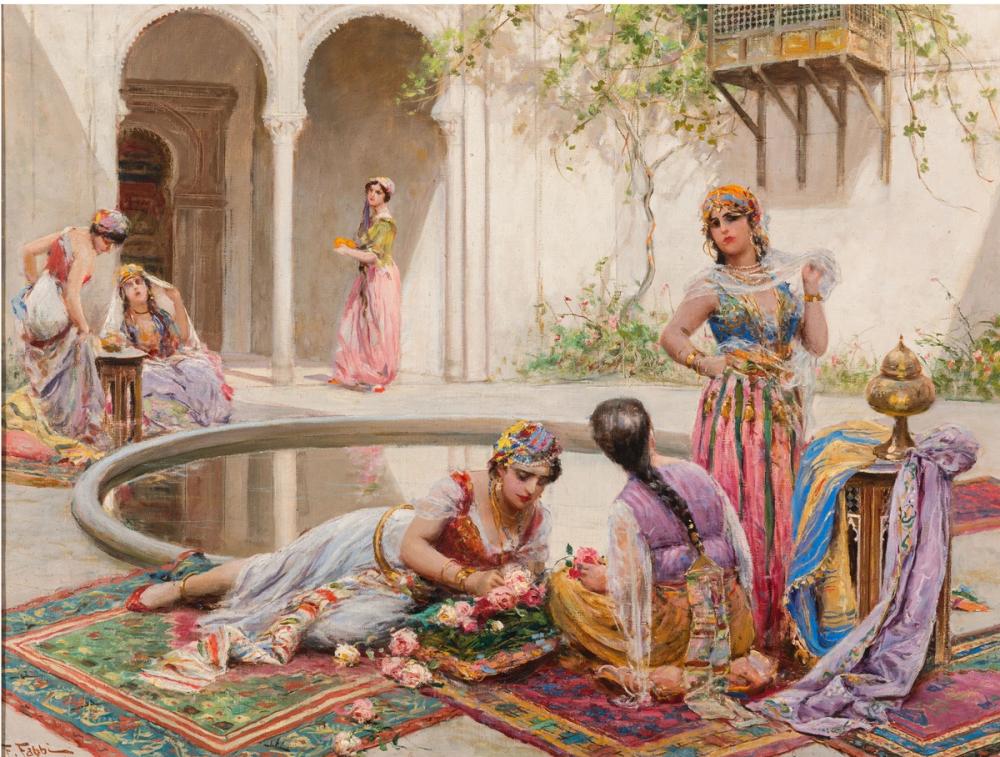
Within weeks of his departure three of his five wives write to him: Zachi reminds him in pornographic detail of a competition among his wives for his attentions. She is proud of her victory and tries to reassert her sexual power over her husband from a distance. Zephis seems more driven by appetite than power. When she gets into trouble for her misbehavior with a slave girl, she writes to Usbek to complain about a eunuch, the “vile slave” who has separated her from Zelida “who so affectionately serves me” (4).Fatima expresses her unrequited desire for Usbek and insists on her love but includes this comment about men before her final amorous profession: “It is difficult for you [men] to make yourself loved; it is quicker to obtain by the desperation of our senses what you do not dare expect from your merit. ”She has never seen an adult male other than her husband, she remarks, yet she swears she would choose him before others; she even claims that he alone deserves to be loved! (7)Fatima is acutely aware of how her passions have been manipulated, but she is resolved to submit, even in his absence.
In general, Usbek writes to his wives only in response to crises of various intensity. For most of the women, frustrated sexual desire is a powerful motive and leads to both complaints and misbehavior. In a letter to Zachi, after a guard has accused her of inappropriate behavior with one of the eunuchs, Usbek defends his authority in the seraglio on the grounds that the constraints he imposes on his wife benefit her: “You must thank me for the constraint in which I make you live because it alone makes you worthy to live,” he writes (20).For the other wives, Usbek insists, the seraglio is a sacred temple, in which “[the female] sex “…loses its weakness and is found invincible despite all its natural disadvantages (20).”In his outraged letter to the chief white eunuch written the same day as the letter to Zachi, he berates his slave, stating “…[you] are in this world only to live under my laws…’; you have “…no soul except my will, no hope other than my felicity (21).” He never retracts these assertions, despite his later, more rational considerations of the merits of polygamy. He fancies himself god-like in his virtuous superiority over both the women and the eunuchs and yet depends upon their love and respect for his own sense of worth.
An observer of political and social institutions, Usbek becomes aware of the disadvantages of polygamy. He argues late in his travels (seven and a half years after his departure) that polygamy is one of the causes of a decline in population: the few children it breeds are weak, he observes. The life of a Muslim husband, he says, is necessarily ‘laborious ; he must be “an athlete destined to fight without rest” (114). In his letter to his friend Rhedi, he offers no defense of the practice he insists on maintaining in his abandoned home. Usbek is contradiction itself, as he says of humans in general and in particular of the French king (33, 37).
Usbek can’t give up power over the seraglio, for his sense of honor is bound up with it. The desire for honor or distinction is the constraining link between Usbek, his wives and their guards. The wives openly compete with each other, partly for his approval, partly to distinguish themselves as individuals. Their developing sense of their worth and desire for independence is bound up not only with sex, but with the desire to love and be loved, while Usbek’s sense of worth requires their willing submission. His sense of personal virtue demands at the same time that he be thought worthy of love. The women and the eunuchs are like alienated portions of his own soul. They constitute the only society he has ever seen himself to be part of. Although he acknowledges only his superiority, his wives and their guards assert the appetites he claims to have sated and thinks he can ignore.
Usbek initiates written discourse with only one of his wives, his favorite Roxane (26).He writes to remind her, recalling the early days of their marriage, of her modest resistance to his advances in their first weeks together, and to contrast her with European women whom he finds corrupt and unlovely. Roxane is fortunate, he claims, that she is kept pure in the seraglio[5].. Among his wives Usbek attributes virtue to Roxane alone, and he asserts his confidence in her love for him. She does not write back. It never occurs to him that when she refused his advances she was moved by hatred and disgust, or that his assaults were an affront to her.
Usbek’s contempt is not less virulent for the eunuchs whom he keeps as guards than for the women: yet he fails to control these parts too of his fractured self. They are either oblivious or incapable of stopping the wives’ rebellion. In the end, they may be complicit. Usbek has separated himself from the despotism of erotic yearning only to enslave himself to souls he laments that he cannot trust to preserve his sense of his wholeness as a man.
A sense of masculine wholeness is precisely, of course, what the eunuchs lack. They are resentful, cruel and often incompetent with the women. Although they enjoy gazing on the beauty of women – the chief black eunuch recounts his delight in a concubine he purchases purportedly for Usbek’s pleasure (79) – the eunuchs’ usual source of satisfaction derives from their ability to thwart every effort of the wives. Usbek does not hate the women; the eunuchs seem to. Still, when the wives openly rebel, Usbek orders the eunuchs to use every possible means to reestablish order. His command comes too late.
While Usbek rejects despotism he is, finally, nothing but a despot. In his little domain Usbek’s power is never openly questioned, and he is so blind to the fact that it is in conflict with his enlightened principles that he is shocked when his power dissolves. One could dismiss Usbek’s depressed state after the rebellion as a consequence of the unique defects of a weak and deluded, even a malevolent, man. But Usbek is no fool: His scientific pursuits have taught him to reinterpret the prejudices and the practices that have shaped him from birth. Moreover, in Persian Letters, Montesquieu indicates that the seraglio is by no means a unique institution. Usbek refers to Christian priests as eunuchs, suggesting a comparison between the Christian church and the Persian seraglio. The Persian women, then, resemble the men and women of Europe whose lives are affected by divine, especially papal, authority. Usbek’s entanglement in despotic ways is more extreme but it is akin to the entanglement of so-called Christian morality with the despotic power of an institution that, Usbek observes, denies to women and to men the dignity of self-governing individuals (75).Montesquieu indicates in this work that the repudiation of sexual desire, eros in its ordinary manifestation, is a sign of the fracturing of the soul. These frustrated yearnings turn humans into mere subjects who can do no more than rebel. They must do so because their condition presupposes false relations among ‘things’.
Usbek made a rational decision in accord with his interest in leaving Persia; his sense of honor ties him to the seraglio for a sense of his worth. His reason and his sense of honor seem irreconcilable. It is Usbek, even more than his wives and his eunuchs, whose passions must be constrained if he is to pursue virtue as he understands it, namely as the unhindered pursuit of the truth insofar as it can be known. But Usbek’s disciplined thought inhibits self-knowledge: he cannot hear his wives’ demands and he cannot make sense of his misery. The problem posed by this book is how to escape despotism in all its forms, including the despotism of the prejudices that govern individuals in spite of things as they are. Usbek’s prejudices are Cartesian; they have rendered him obtuse to the complexities of a human soul, his own.
III. Rebellious Subjects, Competing Despotisms.
Usbek’s thought progresses during his nearly nine year absence from Persia. The women too progress, perhaps in their understanding of their oppression, certainly in their determination to resist it.Their early letters indicate how differently from one another they try to relieve their oppression. Zachi writes to Usbek to talk about her victory in the competition for Usbek’s attention: she goes into graphic detail in a clear attempt to renew her power over her absent lord (2).He does not respond. Zephis does her best to find satisfaction wherever she can. She tries to get Usbek to intervene in response to her reminders of their love and her tears[6] (4). She fails too. Fatme or Fatima, whose name recalls the daughter of Mohammed, displays her intelligence and her determination to show Usbek her great worth: she knows how her passions are manipulated by the institution of the seraglio, but she accepts her fate and professes love for Usbek nonetheless. No response. Zelis writes later than the others but repeatedly: she tries to clarify the bizarre rules of the seraglio with a series of questions: Can eunuchs legitimately marry? Is there any redress for the father of the bride against a groom who claims falsely that she is not a virgin? Zelis’s questions are potentially rebellious, despite her explicit embrace of the rules of the seraglio. She explains her decision to isolate her seven year old daughter in the seraglio by saying “It is vain to talk to us of the subordinate position in which we are put by nature …. we must be made to practice submission, so that it sustains us in those critical moments when the passions begin to arouse and encourage us to independence (62).”Later, Zachi will be found in bed with a eunuch and Zelis will drop her veil to show her face on her way to the mosque (147). Both women write to Usbek to complain of their punishments. A young man is found in the seraglio (149). Usbek’s favorite, Roxane, writes only two letters, and they come in quick succession. First, a full nine years after Usbek’s departure, she writes to complain of the eunuchs’ new campaign of terror (156).Roxane turns out to have a lover with whom she has slept right under the noses of her guards. In the very last letter of the book, Roxane writes to Usbek only to reveal that she has always abhorred him. She has, she says, always been free.
Roxane is especially proud of her deception of Usbek and of the eunuchs. In her dying letter, she includes this barb:
How could you have imagined me credulous enough to believe that I existed only to adore your caprices, that in permitting yourself everything, you had the right to thwart my every desire? No: I have lived in slavery, but I have always been free. I reformed your laws by those of nature, and my spirit has always held its independence (161).
She has slain the eunuch who killed her lover, and when she writes she is dying from a poison she has taken. But she still cares about Usbek’s opinion of her: she wonders “Is it possible, after crushing you with sorrow, that I may yet force you to admire my courage?”
Roxane’s vengeance is powerful, but her freedom is limited. The women assess their situation accurately: no matter how freely they think, they persist as subjects who can do nothing but risk all in more or less violent rebellion against the power that oppresses them. They strive for nothing but the free expression of their individual selves. They are subjects to the end.
The eunuchs, too, display their unrelenting need to assert themselves. They begin by admiring the beauty of the women, but for them there is no good but the exertion of the power that remains to them once their own passions have been torn from their natural end.
The seraglio has effectively turned the women and their guards into alienated parts of the soul of the lord and husband, and it is no wonder that none can thrive on their own. If Usbek is correct, the seraglio is intended as an attempt to unify the soul in marriage, and it does so by isolating its parts to make the passions more manageable (22) and so to free the lord and master to pursue higher ends. It sacrifices a multitude of others, both men and women, and makes them into subordinate and partial beings. There is no question Persian Letters is an attack on these grounds on despotism of all sorts. For despotism is not limited to the overt oppression of one human being or more by another. The despotism of the passions is a danger; the despotism of narrow Cartesian rationalism is the complementary threat.
Conclusion
Usbek’s intellectual liberation parallels his wives’ attempts to satisfy their passions and their growing self-assertion. A complete understanding of the human would have to integrate the two. I have focused on Usbek, whose scientific bent leads him to a sort of Cartesian political science, something Descartes seems never to have attempted. Usbek discovers what he understands to be laws that govern humans everywhere, but he fails to extend those laws to include his own experience. He never considers that each human, himself included, must be a part of a particular society with attachments to particular other humans, sources of mutual respect. He is oppressed by his attachment to his unloved wives when he travels west in pursuit of knowledge, and he is enraged and depressed when they rebel. Usbek’s enlightened ideas have done nothing to prepare him for the disaster he experiences when Roxane rebels.
Usbek’s broken state at the end of the novel is an image of the collapse of the connection between the Christian God and the God who guarantees the truth of Descartes’ clear and distinct ideas. The God who supports Cartesian science in no way addresses the yearnings of the human soul. No human, the scientist included, lives and thinks in detached isolation from others. Usbek’s failure to recognize his kinship with other human souls is the failure of the stateless, impersonal and, in a certain fashion soulless, Cartesian ‘I’.
The problem of the fractured soul, not only Usbek’s problem, but also the problem that afflicts all his subjects, is a problem for any of us who pursue knowledge within the limits set by the Cartesian understanding of rational truth. In the Persian Letters Montesquieu highlights the relations between men and women. In so doing, he emphasizes the particularity of human attachments that Usbek neglects. Here, as in The Spirit of the Laws, Montesquieu corrects Cartesian science by developing it more fully: The laws that govern humans are not confined to those that determine the effects of physical laws plus others that govern the relations of intelligent beings. Any science of human things is inadequate so long as it cannot account for the true relations between the aspects of the human soul. These include eros and the love of honor, and they appear differently under different circumstances, in different nations, in the relations of individual human beings.
The Persian Letters was immensely popular in its time. No doubt its barbed critique of almost every aspect of French society resonated with contemporary readers. Montesquieu, remaining anonymous, exploited the laxness of eighteenth century French upperclass sexual mores to sell books, no doubt, but also to seek truth. In his “Reflections on the Persian Letters” Montesquieu gives his apology for the book. He says: “This justification the author submits out of his love for these great truths, to say nothing of his respect for the human race, which he never intended to strike in its most tender spot.” The sensitivity of the place in our souls where honor and eros are linked leads to curious distortions.
In this book, priests appear as eunuchs, the Cartesian claimant to God’s throne as the despotic, absent lord of a seraglio, the Pope and the King of France as magicians and both men and women as subjects of two kinds of despots – that of the eunuchs and that of their Cartesian lord.In the Persian Letters, Montesquieu charms his reader while he assaults the reader’s defenses against the prying of his post-Cartesian ‘I,’ which aspires to develop a science of human affairs. The ‘great truths’ (his phrase) he offers in the Spirit of the Laws must provide the full justification for this work’s indelicacy. A science that ignores the passions and prejudices of erotic beings cannot distinguish liberation from slavery.It is a ready tool for tyranny.
[1]Essai d’observations sur l’histoire naturelle, OC, t. VIII, p. 213
[2] Cf. contradictory nature of French king, according to Usbek, letter 37, second paragraph
[3] Later Usbek’s friend Ibben forwards to him an account of the lives of a pair of Zoroastrian or Guebre lovers, brother and sister, who live quietly in accord with their unusual religious convictions.The Guebres seem to be virtuous, at least if sibling incest is no vice, but they are isolated. It is difficult to imagine a society of such people, who consistently marry their siblings, although it is said to be an ancient practice of the entire Guebre society (see Herodotus on Cambyses, III.31).The problem of how a society can be ruled in accord with virtue is presented and left unsolved. The example of the Guebres indicates that a tolerant society can facilitate the lives of virtuous individuals and families in private, although it may not be able to promote such lives. The Troglodytes and the Guebres seem similar, even to the point that the earliest public minded Troglodyte families may have been incestuous.Their self-interest is completely absorbed into the whole of which they are a part (67).
[4] Although Usbek doesn’t acknowledge it, the seraglio is an image of the sultan’s rule in Persia, Perhaps he ought to make a distinction between public and civil law.
[5] Usbek has a strict sense of the beautiful, unlike perhaps his more corruptible friend Rica. For Usbek, beauty must be preserved in isolation from ordinary human needs and activities, pure of human taint.
[6] Discuss movements of Zelida.